
By Ellard Thomas, MBA · Smarter Business Growth
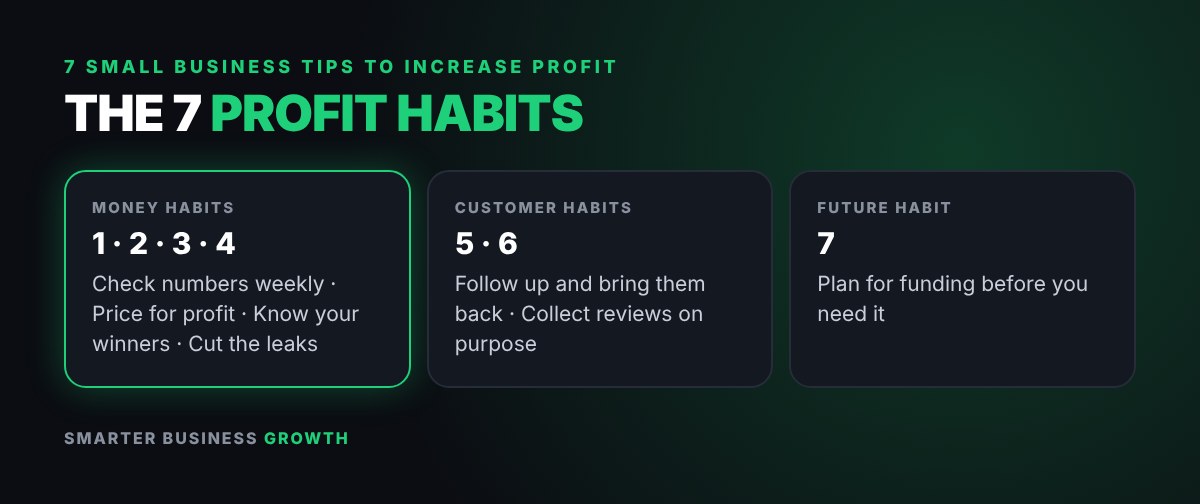
Quick answer: The best small business tips to increase profit are habits, not hacks. Check your numbers every week, price for profit, know which products or services actually earn the most, cut cost leaks, follow up and bring customers back, collect reviews on purpose, and plan for funding before you need it.
Whether you run a shop, a service business, a restaurant or an online store, you may be working hard with orders coming in and still find there’s never enough left at the end of the month. If that sounds familiar, you’re not alone. Being busy and being profitable are two different things.
Profitable small businesses usually aren’t doing anything complicated. They stick to a few simple habits. Below are seven of them in three groups, with a quick way to start each one this week.

In this article
Score yourself as you read with the one-page 7 Profit Habits Scorecard (printable).
Revenue vs profit: the one idea to understand first
Revenue is everything that comes into your business. Profit is what’s left after everything goes out: inventory or supplies, rent, shipping, software, payroll and your own pay.
A business can have strong revenue and still have very little profit. That’s why “high revenue but no profit” is such a common frustration. Every habit below is about protecting that second number.
Money habits (1 to 4)
Habit 1: Check your numbers every week
Don’t wait for tax season. Block 15 minutes on the same day each week and look at three things:
- What came in this week
- What went out this week
- What’s still owed to you (unpaid invoices)
A cleaning service might find two invoices nobody paid. An online shop might notice shipping costs creeping up. A café might see one supplier’s prices jumped. If cash always feels tight, our guide to small business cash flow explains the difference between cash flow and profit.
Habit 2: Price for profit, not just to make the sale
Many owners set prices by checking what competitors charge and going a little lower. Your price has to cover three things:
- Your costs (product or materials, shipping or travel, software, help)
- Your time
- A profit on top
That’s true whether you sell a product, a service or your expertise. If a price only covers the first two, each new sale makes you busier without making the business healthier. When a customer says “that’s too expensive,” see how to handle price objections.
Habit 3: Know your winners
Most owners know what sells the most. Far fewer know what earns the most, and the two are often different. A café’s best-selling drink may earn little after ingredients and prep time, while a simple pastry earns more on every sale. A consultant’s biggest package may take so many hours that a smaller one is worth more per hour.

Try this: list your top products or services. For each one, note what it costs you and how much time it takes. Then feature, recommend and make it easy to buy your real winners.
Habit 4: Cut the leaks
Small costs add up quietly. Once a month, check:
- Subscriptions: did you actually use it this month?
- Products and services: which ones take the most time or money for the least return? (Habit 3 shows you.)
- Busywork: what could a simple tool handle for you?
Our guide to AI tools for small business shows where to start.
Customer habits (5 and 6)
Habit 5: Follow up and bring them back
Some of your easiest revenue comes from people who were already interested: someone who asked for a price, sent a message or left items in their cart. Follow up the same day, on day 3 and once more on day 7.
Then, after every sale, thank them and give them a simple reason to return: a punch card, a reorder reminder or a note when it’s time for the next visit. Keeping a customer usually costs far less than finding a new one. The full system is in how to get more customers (and keep them coming back).
Habit 6: Collect reviews on purpose
Reviews help new customers choose you without paying for ads, whether they live on Google, Facebook, Etsy, Amazon or your own website.
- Ask right after the sale, while the experience is fresh
- Send your direct review link so it takes seconds
- Reply to every review, good and bad
Here’s a step-by-step system for getting more Google reviews.
Future habit (7)
Habit 7: Plan for funding before you need it
The hardest time to find money is when you need it tomorrow. Businesses that stay healthy tend to:
- Keep a small cash cushion
- Keep their records clean and current (Habit 1 helps here)
- Learn their funding options before an emergency, a slow season, new equipment, more inventory or a big opportunity
Educational only, not financial advice. To understand your options ahead of time, get the free Small Business Funding Playbook or visit resources.fundingalliances.com.
Your 7-habit scorecard
| Habit | Yes / Not yet |
|---|---|
| 1. Check your numbers every week | |
| 2. Price for profit | |
| 3. Know your winners | |
| 4. Cut the leaks | |
| 5. Follow up and bring them back | |
| 6. Collect reviews on purpose | |
| 7. Plan for funding before you need it |
Count your “not yets,” then pick just one and start it this week. Want a printable version? Download the 7 Profit Habits Scorecard.
Small business profit: FAQ
What’s the difference between revenue and profit?
Revenue is all the money that comes in from sales. Profit is what’s left after every cost is paid, including your own pay. A business can grow revenue while profit stays flat or shrinks.
How often should I check my business numbers?
Weekly works well for most small businesses. A short, regular check helps you spot unpaid invoices, rising costs and slow months early.
How do I know which products or services are most profitable?
For each one, compare the price with what it costs you, including your time. The ones that leave the most after costs are your winners, even if they aren’t your best sellers.
What’s a quick way to increase profit in a small business?
Start with the habit you scored “not yet” on. For many owners, checking prices (Habit 2) and finding their real winners (Habit 3) are good first steps.
Want more quick wins? Follow Smarter Business Growth on YouTube, Instagram, TikTok, Pinterest and LinkedIn for weekly lessons.
Educational content only, not financial advice. Smarter Business Growth is not a lender. Examples are for illustration.

ABOUT THE AUTHOR
Ellard Thomas, MBA
Ellard is the founder of Smarter Business Growth and a business consultant with 20 years of experience helping small business owners grow, from getting customers to understanding funding.
Watch Smarter Business Growth on YouTube · Follow @smarterbusinessgrowth on Instagram


Leave a Reply