
By Ellard Thomas, MBA · Smarter Business Growth
Quick answer: When a customer says your price is too high, don’t jump to a discount. Ask what they’re comparing it to, tie the price back to the problem they want solved, show what’s included, offer a smaller option instead of a lower price, and make the next step easy with a payment plan or a set follow-up. Most price objections are really about value, trust or timing, not the number itself.
In this article
Why do customers say your price is too high?
“It’s too expensive” is rarely the whole story. It usually means one of these:
- They don’t see the value yet. They know the price but not everything they get for it.
- They’re comparing apples to oranges. A cheaper quote may leave out things yours includes.
- They don’t trust the result yet. They’re not sure it will work or that you’ll deliver.
- It’s a cash-flow question. They can afford it, just not all at once.
- It’s a reflex. Some people push back on every price to see what happens.
Your job isn’t to argue. It’s to find out which one you’re dealing with, then answer that.
5 things to say when a customer says it’s too expensive
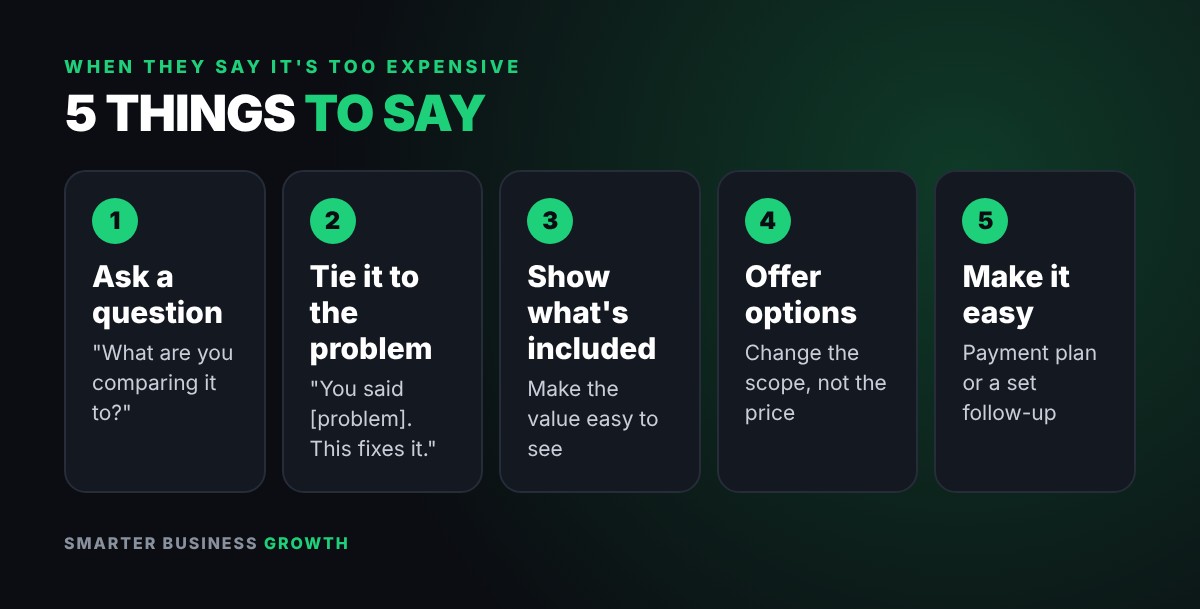
1. Ask a question first
Pushback feels like a no, but it’s really a request for more information. Stay calm, agree it’s a real decision, and ask.
Say: “That’s fair, it’s a real investment. Can I ask what you’re comparing it to?”
Their answer tells you whether it’s value, a competing quote, timing or budget.
2. Tie the price back to their problem
People don’t buy a service; they buy the result. Remind them of the problem they told you about and what it costs them to leave it unsolved.
Say: “You mentioned the old paint is peeling and you’re hosting the holidays. This gets it done right, before your family arrives.”
3. Show what’s included
A price on its own looks big. A price next to everything it covers looks fair. Walk through what’s included, especially anything a cheaper option might leave out: prep work, materials, cleanup, a warranty, or how fast you respond.
Say: “The full project is $4,800, and here’s what’s included.”
4. Offer options, not discounts
If budget really is the issue, change the scope instead of the price. A smaller package keeps your price fair and gives the customer a real choice.
Say: “If we keep the walls and skip the ceilings for now, it comes to $3,900. Would that work better?”
5. Make the next step easy
Sometimes the price is fine and the timing isn’t. Offer a simple payment schedule, or give them space with a clear follow-up so the conversation doesn’t just fade away.
Say: “Would it help to split it into a deposit now and the rest when we finish? Or take a couple of days, and I’ll check in Thursday.”
Then follow up when you said you would. Our 5 steps to get more customers includes a simple same-day, day 3, day 7 follow-up rhythm, and our 10 AI prompts include one that drafts a no-pressure quote follow-up for you.
What not to say
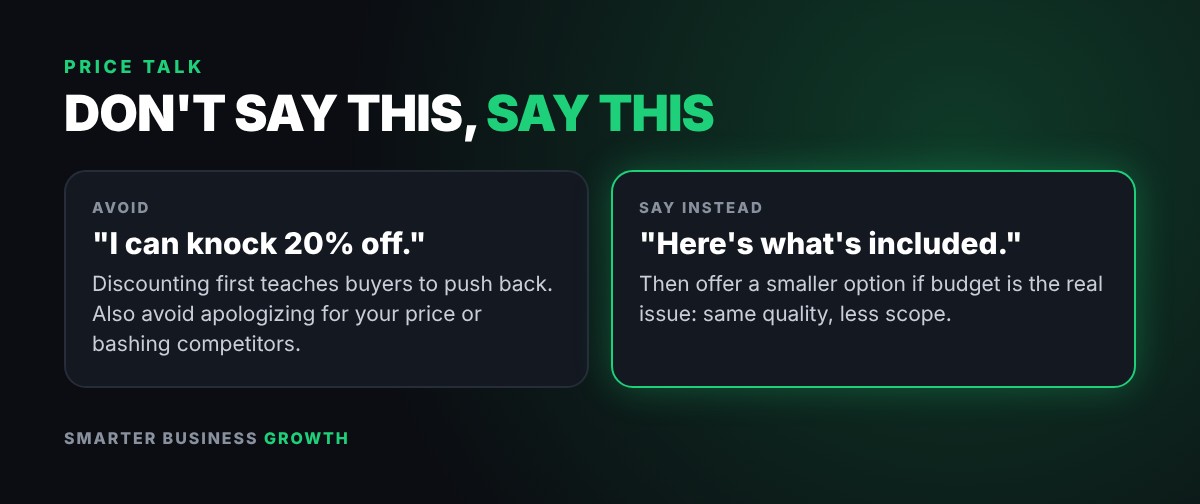
- Don’t lead with a discount. It tells the customer your first price wasn’t real, and it teaches them to push back next time.
- Don’t apologize for your price. “I know it’s a lot, sorry…” makes you sound unsure you’re worth it.
- Don’t over-explain. A long defense sounds nervous. Say what’s included, then pause.
- Don’t bash competitors. Explain what you include and let the customer compare.
How to prevent price objections before they start
The best way to handle price objections is to get fewer of them:
- Qualify early. Ask about budget and timing on the first call so nobody is surprised later.
- Show a starting price. A “from $___” on your website filters out people who were never a fit.
- Lead with the result. Talk about the problem you solve before you talk about price.
- Price with confidence. Know your costs and your profit, so you know your price is fair. If you’re not sure, start with the short video below.
- Say it once, clearly, then pause. Let the customer answer first.
Worked example: a painter’s $4,800 quote
Marco runs a small painting company. He quotes $4,800 to repaint the inside of a home. The homeowner says: “Another company quoted $3,500.”
Instead of dropping his price, Marco asks what the other quote included. It turns out it covered the walls only, with no repairs to the drywall and no ceilings. Marco walks through his quote line by line: patching and sanding, two coats, ceilings, furniture moved and covered, cleanup, and a one-year touch-up promise.
Then he offers a choice:
- Full project: $4,800, paid as a deposit up front and the rest when the job is done.
- Walls and repairs only: $3,900, with ceilings added later if they want.
The homeowner now understands what each price buys and gets to choose. Whichever they pick, Marco kept his prices fair, didn’t discount his work, and gave them a clear reason to say yes.
Example numbers only. Your prices and what you include will be different.
Price objections: FAQ
What do you say when a customer says your price is too high?
Start with a question: “That’s fair, can I ask what you’re comparing it to?” Then tie the price to their problem, show what’s included, and offer a smaller option if budget is the real issue.
Should I offer a discount when a customer pushes back on price?
Usually not as your first move. Change the scope instead of the price, or offer a payment schedule. If you do offer a discount, tie it to something, such as booking by a certain date or paying in full up front.
How do I know if a price objection is real?
Ask questions. If they’re comparing a quote that includes less, it’s a value question. If they like the work but can’t pay all at once, it’s a timing question. If they push back on everything, it may just be a reflex.
How can I stop getting price objections?
Qualify customers early, show a starting price on your website, lead with the result you deliver, and say your price clearly and confidently.
Want more quick wins? Follow Smarter Business Growth on YouTube, Instagram, TikTok, Pinterest and LinkedIn for weekly lessons.
Educational content only. Examples are for illustration.

ABOUT THE AUTHOR
Ellard Thomas, MBA
Ellard is the founder of Smarter Business Growth and a business consultant with 20 years of experience helping small business owners grow, from getting customers to understanding funding.
Watch Smarter Business Growth on YouTube · Follow @smarterbusinessgrowth on Instagram


Leave a Reply