By Ellard Thomas, MBA · Smarter Business Growth
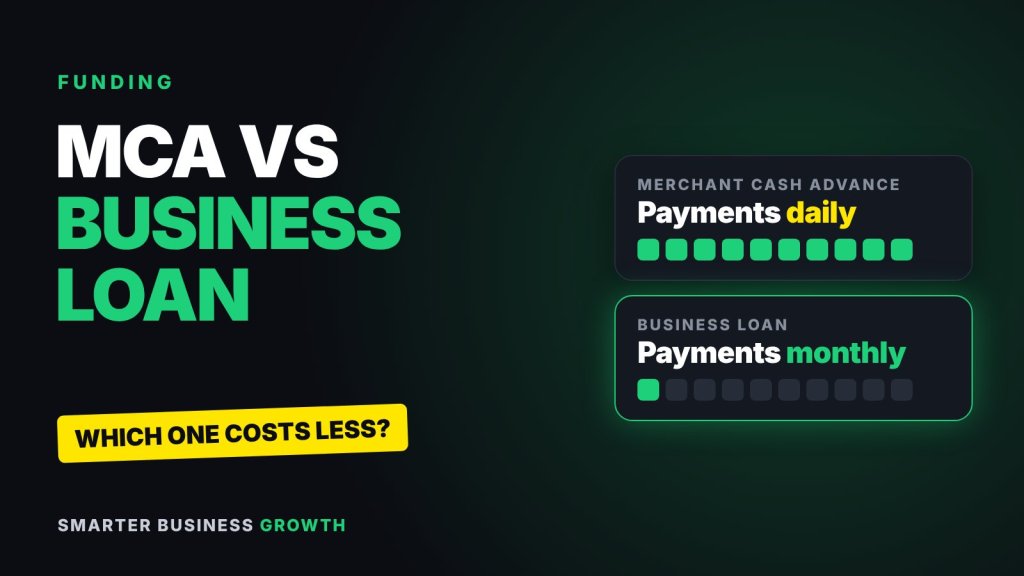
Quick answer: A business loan is usually cheaper and easier on cash flow, with monthly payments spread over a longer term. A merchant cash advance (MCA) is faster and easier to qualify for, but it typically costs much more and is repaid daily or weekly from your sales. If you can qualify for a loan and can wait a little longer, a loan is usually the better choice.
MCA vs business loan at a glance
| Merchant cash advance | Business loan | |
|---|---|---|
| What it is | Sale of future revenue | Borrowed money repaid with interest |
| How cost is set | Factor rate (fixed cost) | Interest rate (APR) |
| Typical payments | Daily or weekly | Monthly |
| Speed | Often 1–3 days | Days to weeks (SBA: often longer) |
| Credit requirements | More flexible | Usually stricter |
| Early payoff savings | Usually none | Often saves interest |
| Typical cost | Often much higher | Usually lower |
What is a merchant cash advance?
With an MCA, a provider gives you a lump sum in exchange for a share of your future sales. You repay it through automatic daily or weekly withdrawals from your bank account, or as a percentage of your card sales, until the agreed total is paid back. The cost is set by a factor rate, like 1.3, so a $20,000 advance means $26,000 to repay.
Because it is structured as a purchase rather than a loan, approval leans heavily on your sales history and bank deposits rather than your credit score.
What is a business loan?
A term loan gives you a lump sum that you repay with interest over a set period, often one to five years, usually in monthly payments. Lenders look more closely at your credit, time in business, revenue and financial records. Government-backed options like SBA loans can offer longer terms and lower rates for businesses that qualify.
Which one costs less? A side-by-side example
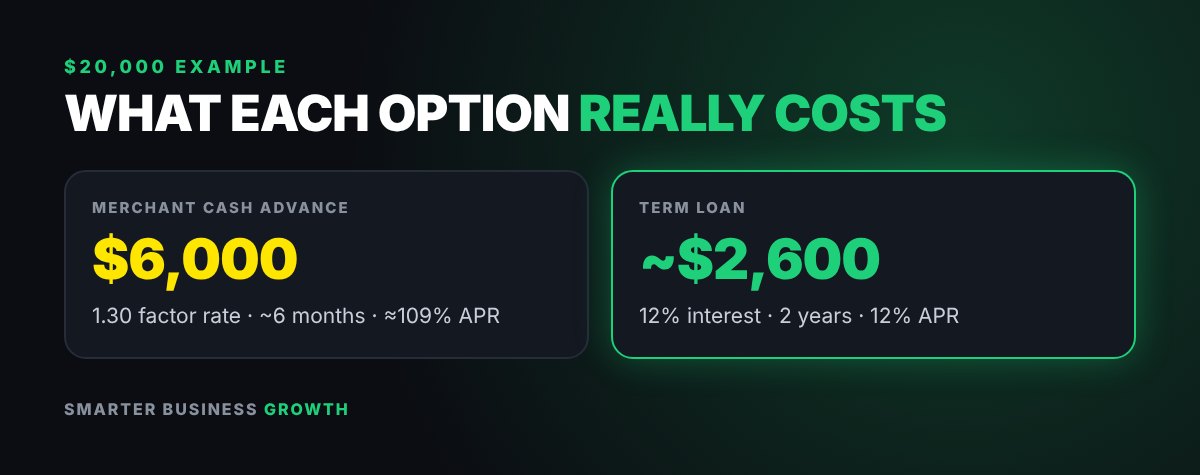
Say you need $20,000. Here is how two typical offers might compare:
| MCA | Term loan | |
|---|---|---|
| Amount | $20,000 | $20,000 |
| Pricing | 1.30 factor rate | 12% interest |
| Term | About 6 months | 2 years |
| Payment | ~$206 every business day | ~$941 per month |
| Total repaid | $26,000 | ~$22,600 |
| Cost of the money | $6,000 | ~$2,600 |
| Approx. APR | ~109% | 12% |
In this example the loan costs less than half as much, and the monthly payment is much easier to plan around than a daily withdrawal. See our guide on how to convert a factor rate to APR to run the numbers on your own offers.
Example numbers only. Your rates and terms depend on the provider and your business.
When an MCA might make sense
- You need money within days and can’t wait for a loan decision.
- Your credit or time in business doesn’t meet loan requirements yet.
- You have strong, steady card sales that can handle daily payments.
- The money will clearly earn back more than it costs, like filling a large, profitable order.
When a business loan is the better choice
- You are making a planned purchase, like equipment, a vehicle or a build-out.
- You want predictable monthly payments.
- You qualify and can wait a little longer for approval.
- You want the option to save money by paying early.
For ongoing or seasonal needs, a business line of credit may fit better than either one.
What daily vs monthly payments feel like
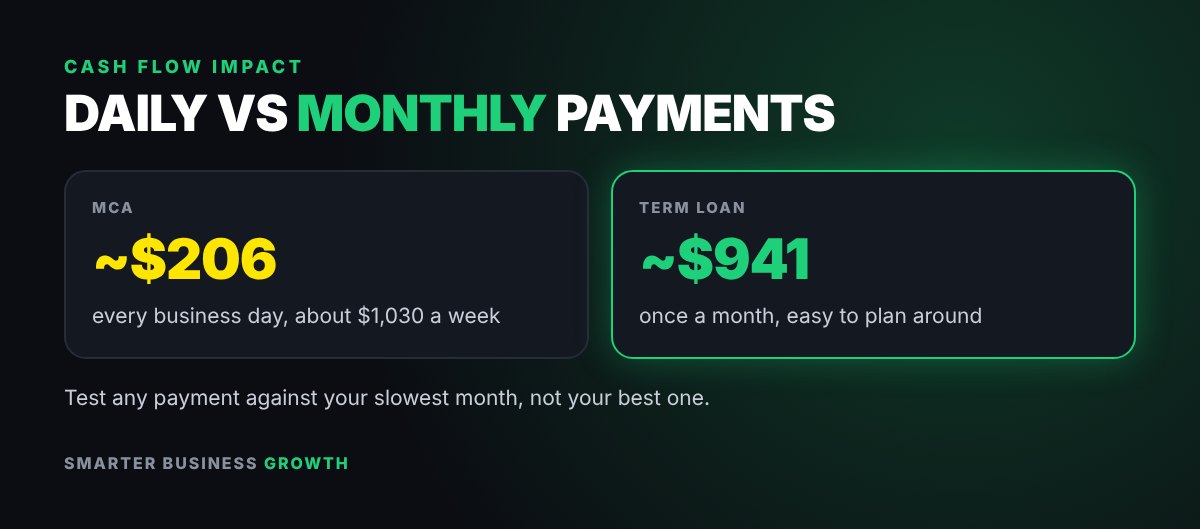
Cost isn’t the only difference. The payment schedule changes how your cash flow feels week to week.
With the MCA above, about $206 leaves your account every business day, roughly $1,030 a week, starting almost immediately. On a slow week, that withdrawal still happens. With the loan, you make one payment of about $941 a month and can plan the rest of your cash around it.
Before choosing, look at your bank statements from your slowest month. Could you cover the daily payment on those days and still pay rent, payroll and suppliers? If the answer is “barely,” the cheaper monthly option protects your business, even if it takes longer to get.
Questions to ask before you choose
- What is the total I will repay, in dollars, and over how long?
- How often are payments taken, and how much is each one?
- What fees come out of the amount I receive?
- Is there a prepayment penalty, or a discount for paying early?
- Do I need to sign a personal guarantee?
- Will you file a UCC lien on my business assets?
Write the answers down for every offer. Seeing them side by side makes the right choice much clearer.
Red flags to watch for with any offer
- Pressure to sign the same day
- No clear total payback amount in dollars
- Fees that aren’t explained, or that come out of your funds without warning
- An offer to pay off one advance with another (stacking)
- Contract terms you can’t get explained in plain English
The Federal Trade Commission has taken action against financing companies that misled small businesses, and its small business guidance is worth a read before you sign anything.
How to get ready to qualify for a loan
- Separate your money. Run all sales through a business bank account.
- Keep statements clean. Avoid overdrafts and negative balance days.
- Get your records together: recent bank statements, a profit and loss statement and tax returns.
- Check your credit, personal and business, and fix any errors.
- Compare options, including the SBA’s free Lender Match tool, which connects you with participating lenders.
Get the free Funding Playbook
See your funding options side by side, what lenders look at and the documents to have ready. It’s sent straight to your inbox.
Frequently asked questions
Is a merchant cash advance a loan?
Usually not legally. It is typically structured as a purchase of future receivables, which is why it is priced with a factor rate instead of an interest rate.
Can I get a business loan with bad credit?
It is harder but sometimes possible, especially with strong revenue or collateral. Improving your bank statements and credit for a few months can open up better options.
Which is faster?
An MCA is usually faster, sometimes funding in a day or two. That speed is a big part of why it costs more.
Can I switch from an MCA to a loan later?
Yes. Some owners use a loan to pay off an expensive advance once they qualify. Compare the total cost first to make sure it actually saves you money.
Does an MCA show up on my credit report?
Many MCA providers don’t report to business credit bureaus, so on-time payments may not help build your credit. A term loan or line of credit that reports can help you qualify for better rates later.
The bottom line
If you can qualify and can wait, a business loan is usually the cheaper, steadier choice. An MCA buys speed and flexibility, and you pay a premium for it. Know the total cost in dollars, test the payments against your slowest month, and choose the option your business can repay without strain.
Want more quick wins? Follow Smarter Business Growth on YouTube, Instagram, TikTok and Pinterest for daily tips.
Educational content only. Smarter Business Growth is not a lender, and this is not financial or legal advice. Rates, terms and approval depend on the lender and your business.

ABOUT THE AUTHOR
Ellard Thomas, MBA
Ellard is the founder of Smarter Business Growth and a business consultant with 20 years of experience helping small business owners grow, from getting customers to understanding funding.
Watch Smarter Business Growth on YouTube · Follow @smarterbusinessgrowth on Instagram


Leave a Reply