By Ellard Thomas, MBA · Smarter Business Growth
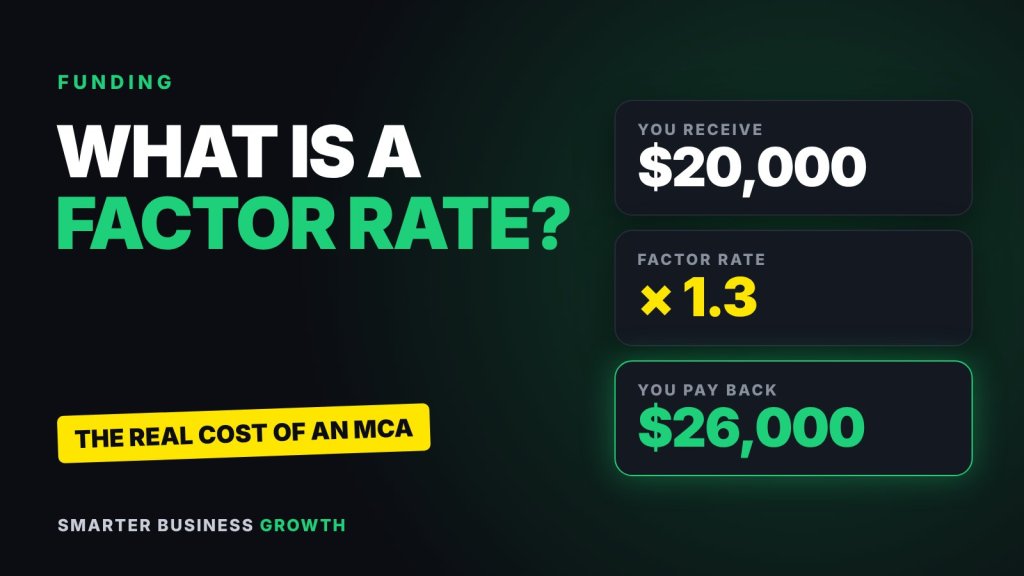
Quick answer: A factor rate is a decimal, usually between about 1.1 and 1.5, that sets the total you will repay on a merchant cash advance (MCA). Multiply the amount you receive by the factor rate to get your total payback. A $20,000 advance at a 1.3 factor rate means you pay back $26,000, and that $6,000 is the cost of the money no matter how fast you repay it.
What is a factor rate?
A factor rate is the pricing used on merchant cash advances and some short-term business financing. Instead of charging interest that grows over time, the provider sets one fixed cost up front. That cost is written as a multiplier, like 1.2, 1.35 or 1.45.
An MCA is technically not a loan. The provider buys a share of your future sales at a discount, then collects that share until the agreed amount is repaid. The factor rate tells you how much more than the advance you will hand back.
How to calculate a factor rate in one step
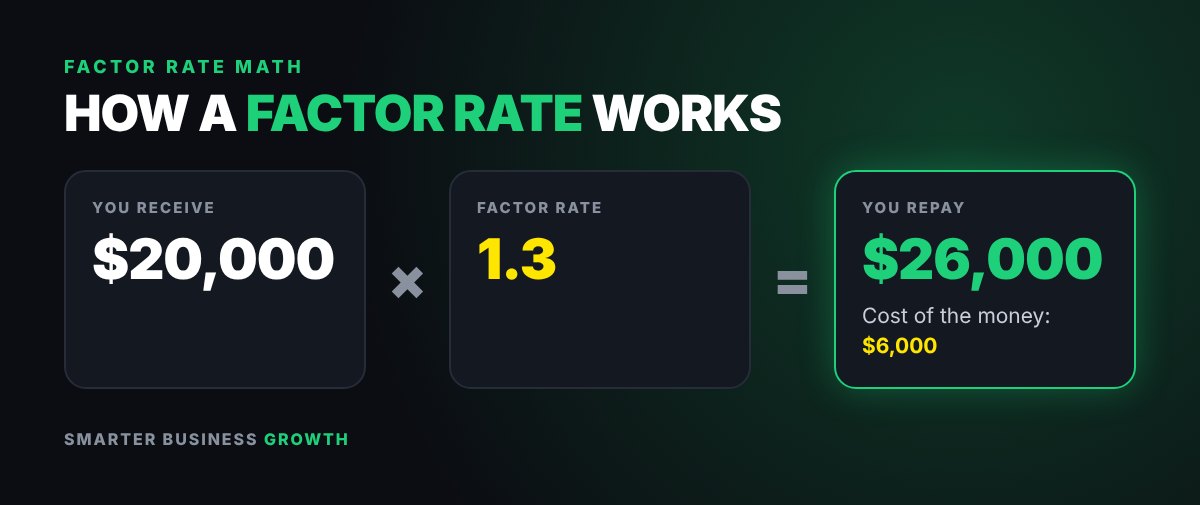
The math is simple: amount received × factor rate = total payback. To see the cost of the money, subtract what you received from the total payback.
| Advance | Factor rate | Total payback | Cost of the money |
|---|---|---|---|
| $10,000 | 1.15 | $11,500 | $1,500 |
| $20,000 | 1.30 | $26,000 | $6,000 |
| $50,000 | 1.40 | $70,000 | $20,000 |
Notice that the cost is fixed the day you sign. On a regular loan, paying early usually saves interest. With a factor rate, the $6,000 in the example above is owed whether you repay in four months or nine.
What is a typical factor rate?
Many MCA offers land somewhere between 1.1 and 1.5. Where yours falls depends on things like:
- Time in business: newer businesses usually see higher rates.
- Monthly revenue and consistency: steady deposits suggest lower risk.
- Bank statement health: overdrafts, negative days and bounced payments push rates up.
- Industry: some industries are seen as riskier than others.
- Existing advances: already having one or more MCAs open (called “stacking”) usually means a higher rate.
- Payback term: how quickly the provider expects to collect.
How you pay it back
Most MCAs are repaid daily or weekly, either as a fixed amount pulled from your bank account or as a percentage of your card sales (often called a “holdback” or “retrieval rate”). With a $26,000 payback over about six months of business days, that is roughly $206 a day coming out of your account.
That daily pull is the part owners feel most. Before you sign, map it against a slow week, not your best week. If your cash flow can’t handle the payment on a slow day, the advance can create the very cash crunch you were trying to solve.
Why a factor rate is not the same as an interest rate
A 1.3 factor rate sounds like “30%,” but it is not a 30% yearly rate. You repay it over a few months, not a full year, and you start paying right away, so the true yearly cost is much higher. In our example, a 1.3 factor rate repaid over about six months works out to roughly 109% APR.
That is why comparing offers by factor rate alone can mislead you. Our step-by-step guide shows how to convert a factor rate to APR so you can compare an MCA against a loan or line of credit on equal terms.
Worked example: comparing two MCA offers
Say you need $20,000 and get two offers:
| Offer A | Offer B | |
|---|---|---|
| Factor rate | 1.25 | 1.35 |
| Total payback | $25,000 | $27,000 |
| Term | 9 months | 6 months |
| Approx. daily payment | $132 | $214 |
| Cost of the money | $5,000 | $7,000 |
Offer A costs $2,000 less and has a much smaller daily payment, but it ties up your cash longer. Offer B finishes sooner but squeezes daily cash flow harder. Neither is automatically “better.” The right one is the offer your business can repay comfortably while still covering payroll, rent and inventory.
Common mistakes with factor rates
- Reading the factor rate as an annual rate. It isn’t one, and the true yearly cost is usually much higher.
- Ignoring fees. Origination, underwriting or wire fees may come out of the amount you receive, which raises your real cost.
- Assuming early payoff saves money. Usually it doesn’t, unless the contract offers an early payoff discount in writing.
- Stacking advances. Taking a second MCA to cover the first is one of the fastest ways to fall into a debt cycle.
- Signing in a rush. Pressure to “sign today” is a red flag, not a feature.
Questions to ask before you sign
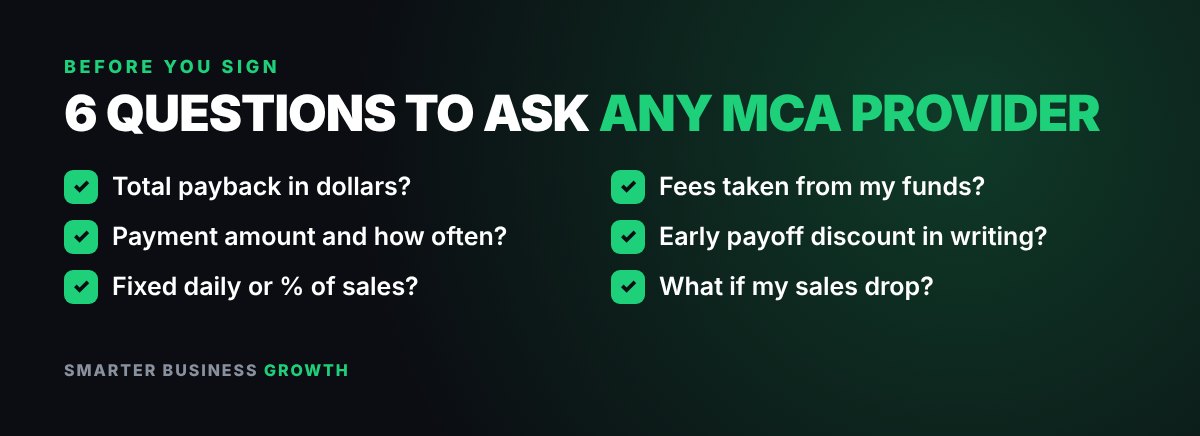
- What is the total payback amount, in dollars?
- How much is each payment, and how often is it taken?
- Is it a fixed daily payment or a percentage of my sales?
- What fees come out of the amount I receive?
- Is there any discount if I pay it off early? Can I see that in writing?
- What happens if my sales drop for a few weeks?
If anyone can’t explain these clearly, slow down. The Federal Trade Commission’s small business guidance is a good place to learn how to spot unfair or deceptive financing practices.
Alternatives to a merchant cash advance
An MCA can make sense for a short-term need when you have strong card sales and few other options. But it is often one of the most expensive forms of funding, so compare it against:
- A business line of credit for ongoing or seasonal needs
- A term loan for a one-time purchase with a known cost
- An SBA-backed loan, which often has longer terms and lower rates if you qualify
- Equipment financing, where the equipment itself secures the loan
Our side-by-side guide to merchant cash advance vs business loan walks through when each one fits.
Get the free Funding Playbook
Learn your funding options, what lenders look at, the documents to have ready and the red flags to avoid. It’s sent straight to your inbox.
Frequently asked questions
Is a factor rate the same as an interest rate?
No. A factor rate is a fixed multiplier on the amount you receive. An interest rate is charged over time on the balance you still owe, so paying early usually lowers the cost.
Is a 1.2 factor rate good?
It is on the lower end of typical MCA pricing, but “good” depends on the term. A 1.2 rate repaid over six months costs far more per year than the same rate repaid over twelve months. Convert it to an approximate APR before deciding.
Does paying early lower the cost?
Usually not, because the total payback is fixed when you sign. Some providers offer an early payoff discount; get it in writing.
Can a factor rate change after I sign?
The factor rate itself is normally fixed in the contract. What can change is how fast you repay if the payment is a percentage of your sales.
Want more quick wins? Follow Smarter Business Growth on YouTube, Instagram, TikTok and Pinterest for daily tips.
Educational content only. Smarter Business Growth is not a lender, and this is not financial or legal advice. Rates, terms and approval depend on the lender and your business.

ABOUT THE AUTHOR
Ellard Thomas, MBA
Ellard is the founder of Smarter Business Growth and a business consultant with 20 years of experience helping small business owners grow, from getting customers to understanding funding.
Watch Smarter Business Growth on YouTube · Follow @smarterbusinessgrowth on Instagram


Leave a Reply