By Ellard Thomas, MBA · Smarter Business Growth
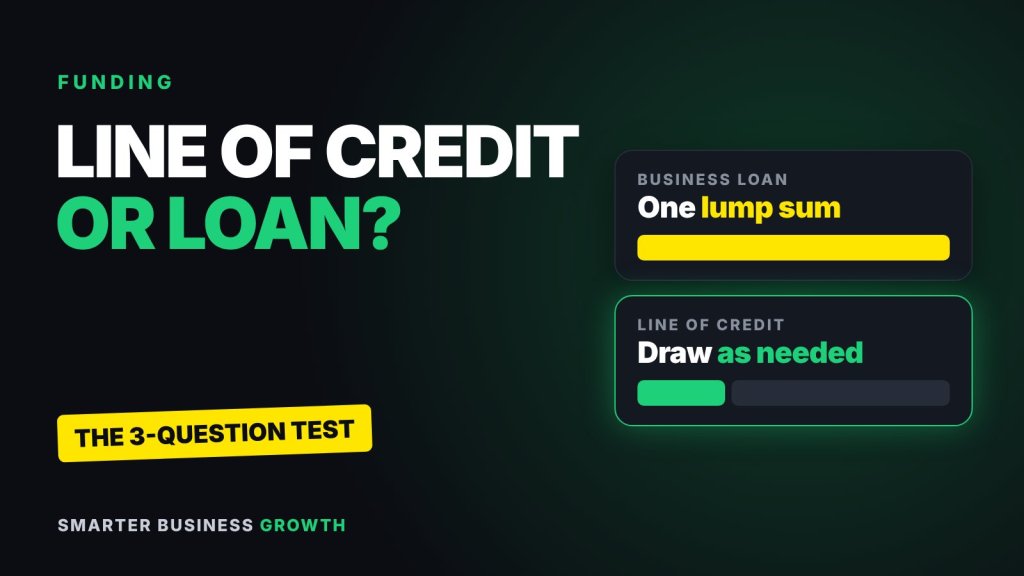
Quick answer: A business loan gives you one lump sum that you repay in set payments, so it fits a one-time purchase with a known price. A business line of credit lets you draw money as you need it and usually charges interest only on what you use, so it fits ongoing needs like slow seasons or short cash gaps.
What is the difference between a business loan and a line of credit?

Think of a loan as buying a tool once for one specific project. A line of credit is more like a toolbox on the wall that you can reach into whenever you need it. Both are useful. They just solve different problems.
| Business loan | Business line of credit | |
|---|---|---|
| How you get the money | One lump sum up front | Draw what you need, up to a limit |
| How you repay | Regular payments over a set term | Pay back what you used, then draw again |
| What you pay interest on | The full amount borrowed | Usually only what you have drawn |
| Best for | One-time purchases with a known cost | Ongoing or changing needs |
| When it ends | Done once it is paid off | Renews (often yearly) if you stay approved |
How does a business loan work?
You get the full amount at once and repay it in regular payments over a set time, maybe one year, maybe several. Payments are usually the same each time, which makes them easy to plan around. Once it is paid off, it is done. If you need more later, you apply again.
Loans work best when you know exactly what you are buying and how much it costs: equipment, a vehicle, a renovation, or buying out a competitor. Longer-term options, including SBA-backed loans, can spread payments over several years.
How does a business line of credit work?
You are approved for a limit. You draw from it when you need to, pay it back, and draw again, a bit like a business credit card with a bigger limit and more structure. The part owners love: you generally pay interest only on what you have actually used.
Types of business lines of credit
- Revolving: as you repay, your available credit refills and you can draw again. This is the most common type.
- Non-revolving: you can draw up to the limit, but repaid money doesn’t become available again.
- Secured: backed by collateral such as inventory, receivables or equipment, often with a lower rate.
- Unsecured: no specific collateral, usually with stricter requirements or higher rates, and often a personal guarantee.
Worked example: what you actually pay on a line of credit
Say you are approved for a $50,000 line and you draw $10,000 for three months at an example rate of 15% a year. Your interest is roughly $10,000 × 15% × 3/12 = about $375, because you pay on the $10,000 you used, not the full $50,000.
Now compare a $50,000 term loan at the same 15% rate: you would pay interest on the whole $50,000 from day one, even if most of it sat in your account unused. (Example numbers only. Real rates and fees vary by lender, and some lines charge draw or maintenance fees.)
The 3-question test: which one do you need?
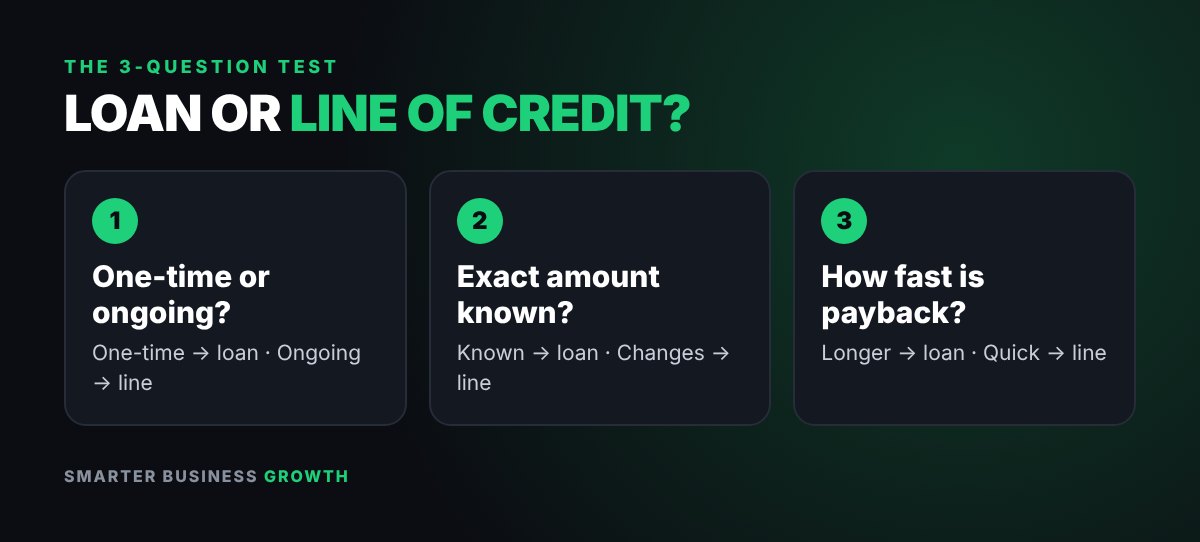
- Is this a one-time expense or an ongoing need?
- Do you know the exact amount?
- How fast will this money pay itself back?
One-time, exact amount and a longer payback usually points to a loan. Ongoing, changing amounts and a quick payback usually point to a line of credit.
Quick quiz: loan or line of credit?
- Buying a $40,000 piece of equipment: one-time with a known price, so it leans loan.
- Sales slow down for two months every winter, but payroll doesn’t: ongoing and repeats every year, so it leans line of credit.
- You won a big contract and must buy materials before the customer pays: a short gap that pays back when you get paid, so a line of credit usually fits.
Can you use both?
Yes, and plenty of established businesses do. A loan covers the big planned purchase, and a line of credit sits in the background for the swings. The goal is to match each dollar to the job it is doing, so you are not paying for a big loan sitting unused in your account or running a large purchase through a line meant for short-term needs.
Costs and fees to compare
| Cost | Business loan | Line of credit |
|---|---|---|
| Interest | On the full amount | On what you draw |
| Origination fee | Common, often a percentage of the loan | Sometimes |
| Draw fees | No | Some lenders charge per draw |
| Maintenance or annual fee | Rare | Common on some lines |
| Prepayment penalty | Sometimes | Rare |
Ask every lender for the total cost in dollars, not just the rate. If you are also weighing a merchant cash advance, our guide to converting a factor rate to APR puts every offer on the same scale.
How to get your business ready before you apply
- Run everything through a business bank account so lenders can clearly see your revenue.
- Keep bank statements clean. Overdrafts and bounced payments are some of the first things a funder notices.
- Keep simple records up to date: a profit and loss statement and your recent tax returns.
- Know where your credit stands, personal and business, and fix errors before you apply.
According to the Federal Reserve’s Small Business Credit Survey, many owners who apply for financing don’t get the full amount they ask for. Getting these four steps in order before you apply improves your odds.
Get the free Funding Playbook
Walk through your funding options, what lenders look at, the documents to have ready and the red flags to avoid. It’s sent straight to your inbox.
Common mistakes to avoid
- Using a line of credit for a long-term purchase. You may end up carrying a balance for years at a variable rate.
- Taking a big loan “just in case.” You pay interest on money you aren’t using.
- Ignoring the renewal date. Lines are often reviewed yearly, and a weak year can shrink or close your line.
- Comparing rates only. Fees and payment schedules can change the real cost a lot.
4 things to check before you sign any offer
- The total amount you will pay back, not just the rate
- The payment schedule: monthly, weekly or daily
- The fees, like origination or draw fees
- For a line of credit, when it renews and what happens then
If an offer feels rushed or nobody can explain those four things clearly, that is your cue to ask more questions or keep looking. For more on comparing offers, see merchant cash advance vs business loan.
Frequently asked questions
Is a line of credit cheaper than a loan?
It can be if you only draw small amounts for short periods, because you usually pay interest only on what you use. For a large one-time purchase repaid over years, a term loan is often the better fit. Compare the total cost of each offer.
Which is easier to qualify for?
It depends on the lender and your business. Both look at time in business, revenue, bank statements and credit. Getting the four prep steps above in order helps with either one.
Does a business line of credit affect my credit?
It can. Many lenders report to business credit bureaus, and some check your personal credit when you apply. Using the line responsibly and paying on time can help build your business credit over time.
Can I pay a business loan off early?
Often, yes, but check for prepayment penalties first. Some loans and most merchant cash advances do not save you money for paying early.
Want more quick wins? Follow Smarter Business Growth on YouTube, Instagram, TikTok and Pinterest for daily tips.
Educational content only. Smarter Business Growth is not a lender, and this is not financial or legal advice. Rates, terms and approval depend on the lender and your business.

ABOUT THE AUTHOR
Ellard Thomas, MBA
Ellard is the founder of Smarter Business Growth and a business consultant with 20 years of experience helping small business owners grow, from getting customers to understanding funding.
Watch Smarter Business Growth on YouTube · Follow @smarterbusinessgrowth on Instagram


Leave a Reply